Bataye WeChat Mini Program
A clearer purchasing journey for food service businesses.
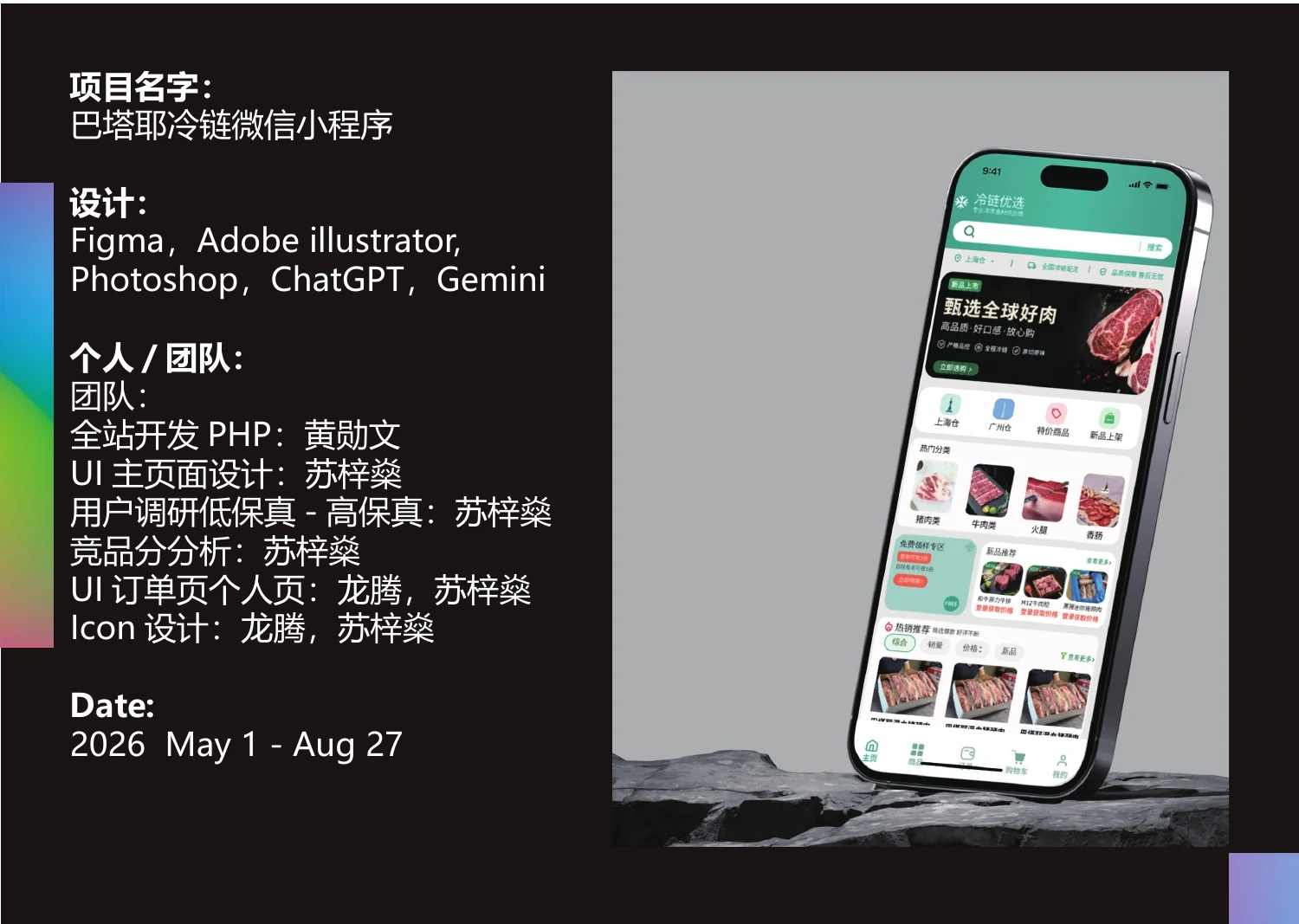
A clearer purchasing journey for food service businesses.
Bataye is a B2B fresh food purchasing mini program for restaurant operators and business customers. The project brings product discovery, customer approval and ordering into one digital channel. I worked across UI design, UX and product definition, translating business requirements into flows, interface designs and development handoff.
Turning business rules into a usable product
Ordering previously depended on separate conversations with sales staff and manual coordination. The new channel needed to organise a growing product catalogue while controlling access to business pricing. Customer registration and approval therefore became central to the purchasing journey.
Making product discovery the priority
The competitor review compared information density, category visibility and the balance between promotion and practical purchasing tasks. The resulting direction prioritised search, clear categories and familiar navigation, with a more deliberate hierarchy for promotional content.
From account approval to repeat orders
The information architecture connects product browsing, categories, customer service, orders and account management. New customers follow an application and approval path, while approved customers can move into purchasing. These paths were mapped before the interface was refined.
Designing around the actual sales process
Wireframes evolved into a consistent green visual system. The design accommodates business-specific requirements such as sales-assisted payment, adjustments for variable product weight, account balances and downloadable order information. Product pages also connect explanations and imagery to the purchasing decision.
Testing in the working mini program
Interaction checks moved from Figma into the working WeChat test version, where page transitions and business flows could be reviewed with the developer and stakeholders. The portfolio records the mini program launching on 12 August 2026, followed by continued refinement.
What this project explores.
The project reached a live WeChat mini program and began bringing existing business customers into the online purchasing system. It developed my ability to connect interface decisions with real operational requirements, communicate with stakeholders and support implementation.
TEAM / 苏梓燊 — UI/UX design · 黄勋文 — PHP development · 龙腾 — shared order/account UI and icon design
Original portfolio pages18 PAGES +
The project as documented in the original portfolio. Select any page to enlarge it.